Send your drawing. Get a quote in 1 business day.
Include your annual volume and tightest tolerance, and we can quote tooling and unit price right the first time.
To vet a Chinese metal stamping supplier, verify the company first, then the factory, then the parts. Check the business license and ISO certificate against public databases, audit the presses, toolroom and inspection equipment by video or on site, and approve a first article with a dimensional report and material certificates before paying for production.
Most problems are not fraud. They are mismatches: a trading company presented as a factory, a certificate that covers a different site, a die built to a cheaper standard than you assumed, or a sample made more carefully than production. Each of these can be checked before you commit money.
The checklist below follows the order we would use as a buyer: company, certificates, factory, process control, first article, commercial terms and shipping.
Ask for a copy of the certificate, then look it up yourself on the CNCA certification database (cx.cnca.cn), which lists certificates issued by accredited certification bodies in China. Search by company name or certificate number.
Check three things: the certificate is valid (not suspended or withdrawn), the scope covers the products you are buying (for example “manufacture of metal stamping parts”), and the address matches the factory you will visit. A certificate held by a sister company or for a different site does not cover your parts.
If you need automotive quality management, ask for IATF 16949 specifically. ISO 9001 is not the same thing.
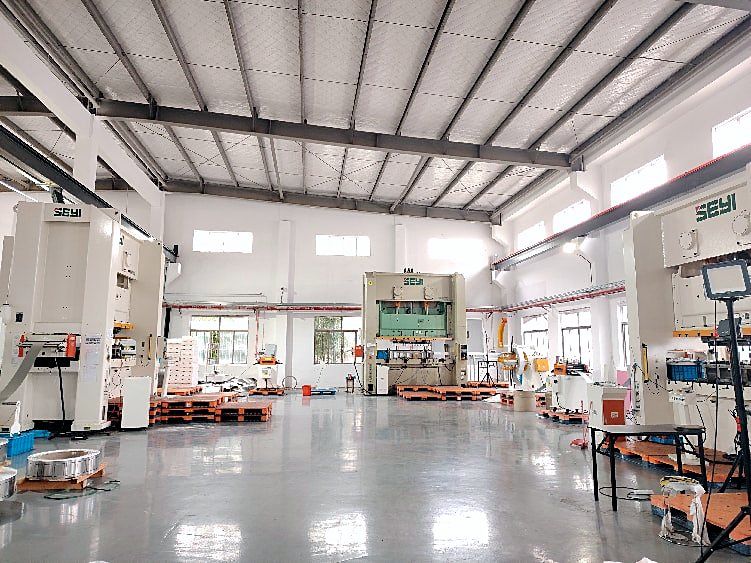
An onsite audit is best. A live video tour is a reasonable first step, provided it is live, unscripted and you direct the camera. Ask to see the following.
| Area | What to look for | Questions to ask |
|---|---|---|
| Presses | Number, tonnage range, make, condition, feeders and coil lines | Which press would run my part? What tonnage does it need? |
| Tooling | In-house toolroom or named tooling partners; die storage and labeling | Who designs and builds the die? Who maintains it? Who owns it? |
| Inspection equipment | Vision measuring system, height gauges, calipers, micrometers, hardness tester | How are critical dimensions checked, and how often? |
| Sampling plan | Documented AQL plan for incoming and outgoing inspection | Which AQL levels apply, and are they agreed per customer? |
| Calibration | Calibration labels and records with dates for gauges and instruments | Can I see the calibration record for the instrument that checks my part? |
| Material control | Labeled coil and sheet stock, traceable to mill certificates | How do you trace a finished lot back to its coil? |
| Nonconforming parts | Marked quarantine area, records of defects and corrective action | Show me a recent corrective action report. |
Sign an NDA before sharing full drawings. For China, an NNN agreement (non-disclosure, non-use, non-circumvention) written under Chinese law and enforceable in a Chinese court gives more practical protection than a generic English NDA.
Agree on one engineering contact who reads your drawings and answers technical questions directly. Slow or vague answers on technical points during quoting usually get worse after the order. Confirm every change in writing with the drawing revision number.
A common structure is a deposit for tooling and material, with the balance due after inspection or against shipping documents. Avoid paying 100% in advance for a first order with a new supplier. Tie payments to milestones you can verify: die completion photos, approved samples, a passed pre-shipment inspection.
Put die ownership, die maintenance and the right to move the die in the contract. Tooling is usually paid by the buyer and should belong to the buyer.
| Red flag | Why it matters | What to do |
|---|---|---|
| Bank account name differs from the contract company | Common sign of fraud or an undisclosed middleman | Do not pay until names match the license |
| ISO certificate not found on cx.cnca.cn, or scope and address differ | Certificate may not cover the factory making your parts | Ask for the correct certificate or treat as uncertified |
| Refuses a live video tour | May not own a factory | Insist on a live tour or onsite audit |
| Quote far below others with no explanation | Often thinner material, lower-grade die steel or skipped inspection | Ask for a cost breakdown and material spec |
| No dimensional report or mill certificate offered | No evidence the parts meet the drawing | Make both a condition of payment |
| Every answer comes from sales, never engineering | Technical questions will stall after the order | Ask for a call with the engineer |
| Unclear die ownership | You may not be able to move your tooling | Write ownership into the contract |
If you are vetting us, we can share our business license and export license, our ISO 9001:2015 certificate for you to check on cx.cnca.cn, our equipment list (13 presses from 60 to 250 T, fiber laser cutting, CNC bending, laser welding), our inspection equipment, and sample dimensional reports and mill test certificates. A live video tour is available on request. Tooling and surface finishing are done by partners, and we will tell you which steps those are for your part.
Check the business scope on the license and on gsxt.gov.cn, ask for a live video tour where you direct the camera, and check that the ISO certificate address matches the site you see.
On the CNCA certification database at cx.cnca.cn. Search by company name or certificate number and check validity, scope and address.
A report that lists every dimension on the drawing with the measured value from a sample part and a pass or fail result. It is the basis for approving production.
For many first orders a live, unscripted video tour plus a good first article is a reasonable start. For critical parts or large programs, an onsite or third-party audit is worth the cost.
A deposit for tooling and material, with the balance after inspection or against shipping documents. Avoid paying everything in advance.
The buyer, once the tooling is paid. Write ownership, maintenance and the right to move the die into the contract.
How your parts are checked from incoming material to shipment, and the documents you receive.
See the presses, spring, laser and molding equipment that make your parts, and how to visit or audit us.
How stamping tooling cost spreads over annual volume, when stamping beats laser cutting, and what to send for an accurate quote. Worked example inside.
Precision metal stamping from Suzhou: shielding cans, terminals, clips and brackets held to ±0.02 mm. MOQ 1,000 pcs, ISO 9001, quotes in 1 business day.
Who we are, who we serve, and how we reduce the risk of sourcing metal parts from China.
Include your annual volume and tightest tolerance, and we can quote tooling and unit price right the first time.