Send your drawing. Get a quote in 1 business day.
Annual volume and your tightest tolerance help us quote tooling and unit price accurately the first time.
Sierxi makes custom compression, extension and torsion springs and wire forms from 0.2 to 2.0 mm wire on six CNC spring machines in Suzhou. Capacity is over two million pieces a month and orders start at 1,000 pieces. Springs can ship together with matching stamped contacts and clips from the same factory.
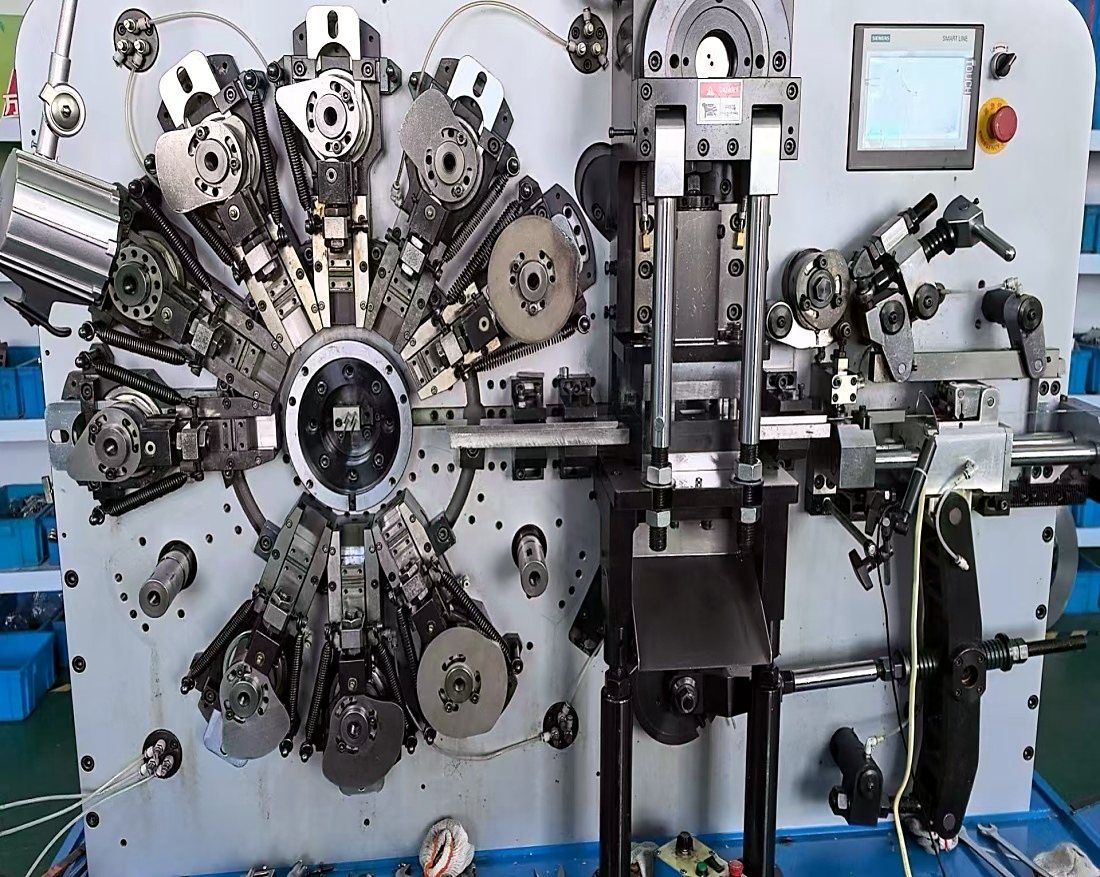
| Machines | 6 CNC spring machines |
|---|---|
| Wire diameter | 0.2–2.0 mm |
| Types | Compression, extension, torsion, wire forms |
| Capacity | 2,000,000+ pcs per month |
| Minimum order | 1,000 pcs |
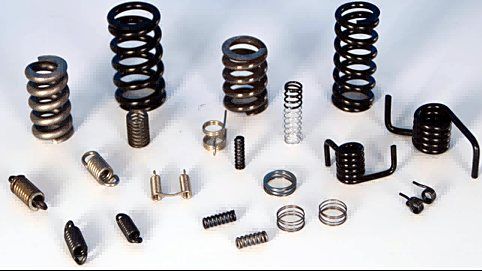
Straight, conical and variable-pitch compression springs, 0.2–2.0 mm wire.
Tension springs with loops and hooks, initial tension to specification.
Single and double torsion springs with custom legs, torque to specification.
| Material (JIS) | Strength | Corrosion resistance | Typical use |
|---|---|---|---|
| Piano wire SWP-A / SWP-B | Very high | Low — needs coating or oil | General mechanisms, indoor products |
| Stainless SUS304-WPB | High | Good | Electronics, food and medical devices, humid environments |
| Stainless SUS631J1 (17-7PH) | Higher than 304 | Good | Higher-stress stainless springs |
| Phosphor bronze | Moderate | Good | Springs that also carry current |
The spring index C is the mean coil diameter divided by wire diameter (D/d). As a rule of thumb, an index between about 4 and 12 coils consistently. Below about 4 the wire is overstressed during coiling; above about 15 springs tangle and dimensions drift.
The rate of a helical compression or extension spring is k = G·d⁴ / (8·D³·n), where G is the shear modulus of the wire, d the wire diameter, D the mean coil diameter and n the number of active coils. Because rate depends on d⁴ and D³, small changes in wire size or diameter move the load a lot — which is why we ask for load at a given length rather than dimensions alone.
Compression springs whose free length is more than about four times the mean diameter can buckle under load unless they run in a bore or over a rod.
| End type | Seats squarely | Cost | Notes |
|---|---|---|---|
| Closed and ground | Best | Highest | Common for heavier wire; less practical on very fine wire |
| Closed, not ground | Good | Lower | Common on fine wire and small springs |
| Open | Poor | Lowest | Rarely used where the spring must sit square |
Wire diameter and material, outer or inner diameter, free length, number of active coils, end type, and the load at a given length (or the rate). For torsion springs, give leg lengths and the torque at a given angle.
Also state which dimensions are critical and the tolerance grade — for example JIS B 2704 or EN 15800 — plus any requirement for set removal, finish or passivation. Finishing is done by qualified partners.
We run an ISO 9001:2015 quality system. Free length, diameters and leg geometry are measured on a vision measuring system at first article. Load at a given length is checked with push-pull gauges. Production lots are inspected by AQL sampling, and a dimensional report can ship with each lot.

Coil springs give long travel and a predictable, near-linear rate in a small diameter. Stamped flat springs and clips fit low-profile spaces, can combine a spring with a contact, mounting tab or locating feature in one part, and are made on a die rather than a spring machine. Many products use both — for example a battery contact plate with a conical coil spring. Because we make both in one factory, we can advise which suits your space and force requirement.
Fine springs, especially extension springs with open hooks, tangle in bulk. Packing — layered trays, separators or small bags — is chosen per part and confirmed in the quote. Freight is quoted per destination.
From 0.2 mm to 2.0 mm wire diameter.
1,000 pieces.
CNC spring machines mainly use standard tooling, so custom springs usually need little or no dedicated tooling. Any tooling cost is confirmed per project in the quote.
As a rule of thumb, a spring index (D/d) between about 4 and 12. Outside that range springs are harder to make consistently.
With push-pull gauges at the specified length, on first articles and production lots.
Yes. We stamp contacts and clips in the same factory, so both can be sampled, inspected and shipped together.
Straight, conical and variable-pitch compression springs, 0.2–2.0 mm wire.
Tension springs with loops and hooks, initial tension to specification.
Single and double torsion springs with custom legs, torque to specification.
Flat springs, grounding fingers and battery contacts.
Austenitic stainless for corrosion-resistant stamped parts and enclosures.
Progressive-die metal stamping in Suzhou: shielding cans, terminals, spring clips. 13 presses 60–250 T, ±0.02 mm, MOQ 1,000 pcs, ISO 9001.
Annual volume and your tightest tolerance help us quote tooling and unit price accurately the first time.