Send your drawing. Get a quote in 1 business day.
Include your annual volume and tightest tolerance, and we can quote tooling and unit price right the first time.
Custom torsion springs, single or double, from 0.2 to 2.0 mm wire, with straight, bent or hooked legs formed to your drawing. We control free angle, check torque at your working angle and supply from 1,000 pieces — often together with the stamped hinge, clip or bracket the spring works with.
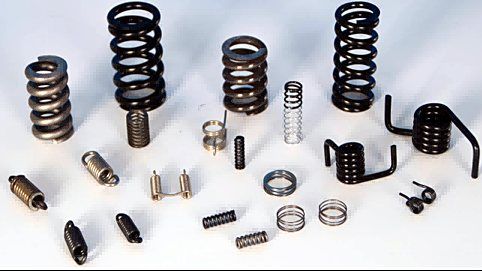
| Wire diameter | 0.2–2.0 mm |
|---|---|
| Types | Single torsion, double torsion |
| Legs | Straight, bent, hooked, custom forms |
| Key controls | Free angle, torque at angle, leg length, wind direction |
| Minimum order | 1,000 pcs |
A torsion spring stores energy when its legs are rotated about the coil axis. It is used in hinges, lids, latches, clips and return mechanisms. The load is a torque — force times the distance from the coil center — at a given angle of rotation.
A torsion spring should be loaded in the direction that winds it tighter. Loading it to unwind raises stress and can cause early failure, so the wind direction (left or right hand) must match how the legs are loaded.
| Parameter | Notes |
|---|---|
| Wire diameter and grade | 0.2–2.0 mm |
| Inner diameter and arbor size | The coil closes in as it winds; we check clearance to the shaft |
| Number of body coils | Affects rate and body length |
| Free angle between legs | With tolerance |
| Torque at working angle | For example N·mm at a stated angle of rotation |
| Leg lengths and shapes | Measured from the coil center; show bends and hooks |
| Wind direction | Left or right hand |
| Coil spacing | Close-wound or with pitch to avoid friction |
A common estimate for torsion spring rate is k ≈ E·d⁴ / (64·D·n) per radian, where E is the elastic modulus of the wire (typically about 206,000 N/mm² for music wire and about 186,000 N/mm² for SUS304 spring wire), d the wire diameter, D the mean diameter and n the number of body coils. Long legs add flexibility, so the measured rate is usually lower than this estimate.
As the spring winds up, its inner diameter shrinks and its body grows slightly longer. Leave enough clearance between the coil and the shaft at maximum rotation — a spring that binds on its arbor loses torque and breaks.
| Single torsion | Double torsion | |
|---|---|---|
| Construction | One coil body, two legs | Two coil bodies wound in opposite directions, joined by a center loop |
| Load | Torque on two legs | Balanced torque; center loop takes the load |
| Typical use | Hinges, clips, latches | Wider lids and covers needing even force |
| Cost | Lower | Higher; more forming |
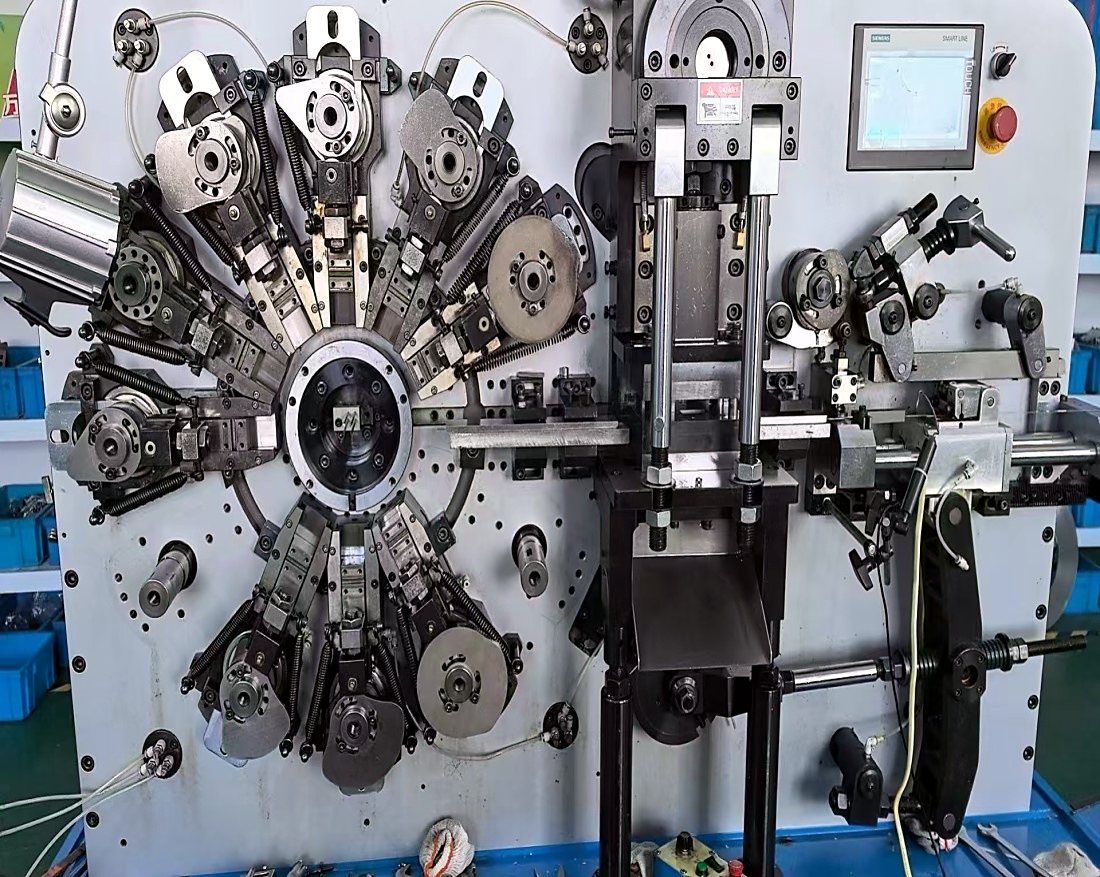
We check free angle, leg lengths, inner diameter and coil count on first articles and sample every production lot to AQL. Torque at the working angle is checked on samples with force gauges and fixtures. A dimensional report and wire material certificates can ship with every delivery.
So that the working load winds it tighter. Show the wind direction (left or right hand) on the drawing and how the legs are loaded.
Yes, from 0.2 to 2.0 mm wire. Give the free angle, torque and center-loop geometry on the drawing.
Yes. Bends and hooks on the legs are formed on CNC spring machines to your drawing.
1,000 pieces per part number.
Most torsion springs fail at the bend where the leg leaves the coil, usually because the bend radius is too tight, the spring is loaded to unwind, or the working angle exceeds the design. Send us the failed part and the drawing and we will review it.
Yes. We stamp brackets, clips and contacts in the same factory, so a spring and its mating part can be developed and inspected together.
Custom precision springs: compression, extension, torsion and wire forms from 0.2–2.0 mm wire, load checked to your drawing. 2M+ pcs/month, MOQ 1,000.
Straight, conical and variable-pitch compression springs, 0.2–2.0 mm wire.
Tension springs with loops and hooks, initial tension to specification.
PCB, connector and mounting brackets stamped from steel, stainless and aluminum strip.
Include your annual volume and tightest tolerance, and we can quote tooling and unit price right the first time.