Send your drawing. Get a quote in 1 business day.
Include your annual volume and tightest tolerance, and we can quote tooling and unit price right the first time.
Custom compression springs coiled from 0.2 to 2.0 mm wire — straight, conical and barrel shapes with open, closed or closed-and-ground ends — with load at your working length checked against the drawing before shipment. Spring capacity is over two million pieces a month, and orders start at 1,000 pieces.
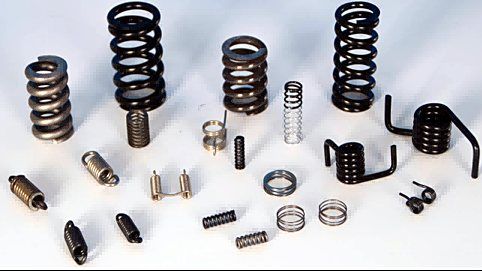
| Wire diameter | 0.2–2.0 mm |
|---|---|
| Shapes | Straight, conical, barrel, variable pitch |
| Ends | Open, closed, closed and ground |
| Load check | Force gauges at your specified lengths |
| Capacity | 2,000,000+ pcs per month (all spring types) |
| Minimum order | 1,000 pcs |
A compression spring is defined by its wire, its geometry and the load it must give at a working length. Specify the load, not just the shape: two springs that look the same can differ widely in force if wire grade or active coils change.
| Parameter | Symbol | Notes |
|---|---|---|
| Wire diameter | d | 0.2–2.0 mm on our machines |
| Outer or inner diameter | OD / ID | Give the one that fits a bore or rod; we control that one |
| Free length | L0 | Length with no load |
| Active and total coils | n / Nt | Total includes the closed end coils |
| End type | — | Open, closed, or closed and ground |
| Load at length | F at L1, L2 | The main functional requirement; one or two points |
| Solid length | Ls | Must be shorter than the shortest working length |
| Material | — | Wire grade and standard |
The rate of a helical compression spring is k = G·d⁴ / (8·D³·n), where G is the shear modulus of the wire, d the wire diameter, D the mean coil diameter and n the number of active coils. Because rate scales with d⁴ and 1/D³, small changes in wire or diameter have a large effect.
The spring index C = D/d should usually sit between about 4 and 12. Below 4 the wire is hard to coil and highly stressed; above 12 the spring tangles and its diameter is hard to hold. We flag designs outside this range when we review the drawing.
| Wire (JIS) | Equivalent | Typical shear modulus G | Use |
|---|---|---|---|
| SWP-A / SWP-B (G 3522) | ASTM A228 music wire | about 78,500 N/mm² | General high-strength springs; needs plating or oil |
| SUS304-WPB (G 4314) | ASTM A313 type 302/304 | about 68,500 N/mm² | Corrosion-resistant springs, electronics, food equipment |
| SUS631J1-WPC (G 4314) | 17-7PH | about 73,500 N/mm² | Higher strength stainless springs |
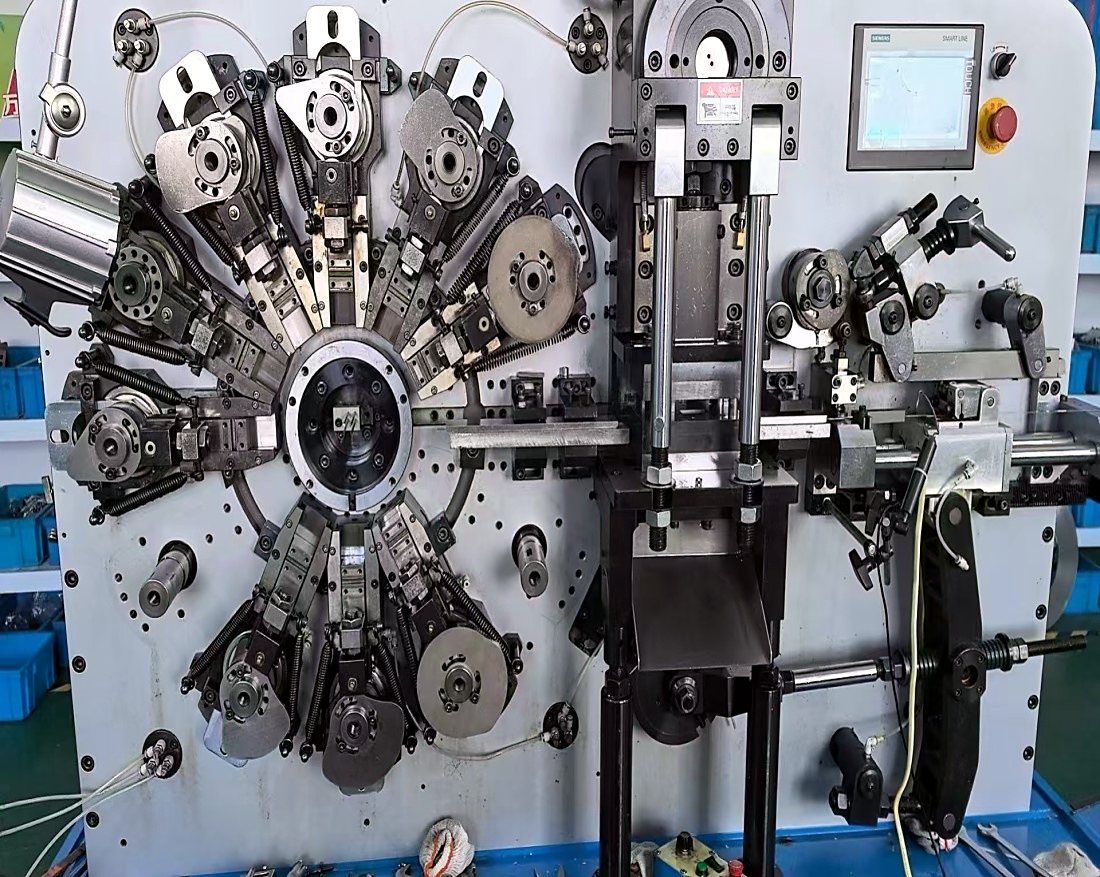
Free length, diameter and coil count are checked on first articles and during production. Load at the specified lengths is checked with force gauges, and dimensions are measured on the vision measuring system for small springs. A dimensional and load report and wire material certificates can accompany each shipment.
From 0.2 mm to 2.0 mm.
1,000 pieces per part number.
A drawing with load requirements is best. We can measure a sample and propose a drawing for your approval, but the load at working length must come from you.
Yes. We stamp contacts and clips on the same site, so matched springs and stamped parts can be developed and shipped together.
Stainless springs are usually supplied passivated or bare; steel springs are oiled or plated. Plating and passivation are done by qualified finishing partners.
Custom precision springs: compression, extension, torsion and wire forms from 0.2–2.0 mm wire, load checked to your drawing. 2M+ pcs/month, MOQ 1,000.
Tension springs with loops and hooks, initial tension to specification.
Single and double torsion springs with custom legs, torque to specification.
Flat springs, grounding fingers and battery contacts.
How we check your parts: ISO 9001, vision measuring, AQL sampling and 100% AOI on critical features, with dimensional reports and mill certs per shipment.
Include your annual volume and tightest tolerance, and we can quote tooling and unit price right the first time.