Send your drawing. Get a quote in 1 business day.
Include your annual volume and tightest tolerance, and we can quote tooling and unit price right the first time.
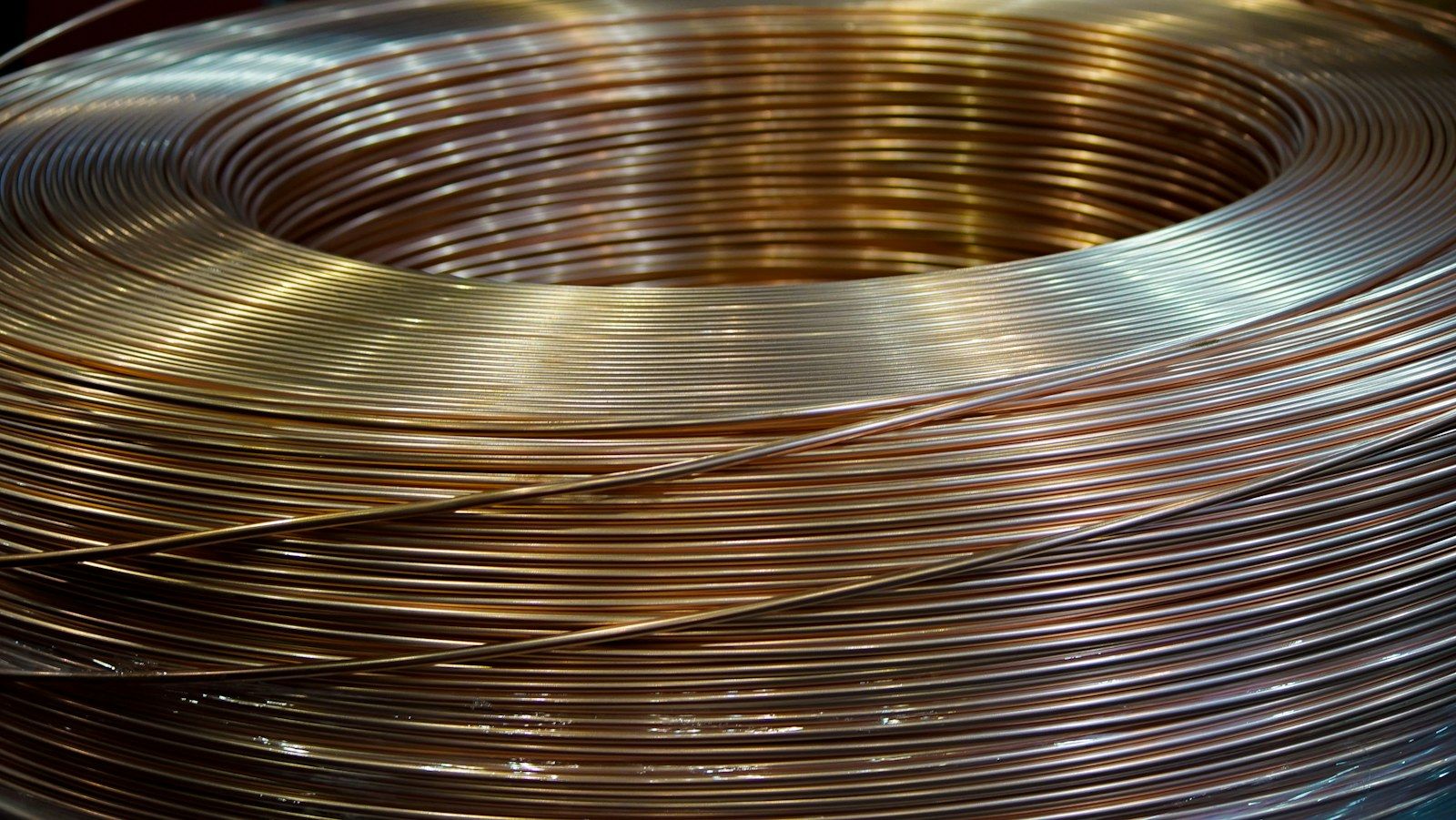
C7701 is a copper-nickel-zinc alloy, often called nickel silver, standardized in JIS H 3130 for spring strip and equivalent to UNS C77000 and CuNi18Zn27. It solders without plating, stays bright and has good spring properties. We stamp C7701 1/2H from 0.15 mm coil for EMI shielding cans, frames and contacts.
| Standard | JIS H 3130 (copper alloy strip for springs) |
|---|---|
| Equivalents | UNS C77000, EN CuNi18Zn27, GB BZn18-26 |
| In production at Sierxi | C7701 1/2H, 0.15 mm coil |
| Typical parts | Shielding cans and frames, spring contacts, terminals |
Despite the name, nickel silver contains no silver. C7701 is roughly 55% copper, 18% nickel and the balance zinc. The nickel gives it a silver-white color, tarnish resistance and higher strength than brass, and the alloy keeps good spring properties in hard tempers.
| Element | Typical range (%) |
|---|---|
| Copper (Cu) | 54.0–58.0 |
| Nickel (Ni) | 16.5–19.5 |
| Zinc (Zn) | Remainder |
| Temper | Tensile strength (N/mm²) | Hardness (HV) | Use |
|---|---|---|---|
| 1/2H | about 540–655 | about 150–210 | Shielding cans and frames with bends |
| H | about 630–735 | about 180–240 | Spring contacts with moderate bends |
| EH | about 705–805 | about 210–260 | Flat springs with gentle forms |
| Property | Typical value |
|---|---|
| Density | about 8.7 g/cm³ |
| Elastic modulus | about 125 GPa |
| Electrical conductivity | about 5–6% IACS |
| Magnetic | Non-magnetic |
| Material | Solderability | Spring properties | Cost | Notes |
|---|---|---|---|---|
| C7701 nickel silver | Good, no plating | Good | Higher | Default for solder-mounted shields |
| SPCC + tin plating | Good when plated | Low | Lower | Plating needed; cut edges unplated |
| SUS304 | Poor | Good in hard tempers | Medium | Strong thin covers, clips |
| Phosphor bronze (C5191) | Good | Very good | Higher | Common for connector contacts |
No. C7701 is copper, nickel and zinc. The name comes from its silver-white color.
Usually not. C7701 solders well bare. Plating can be added through our partners if your process requires it.
Sometimes. C7701 is cheaper to solder and stays bright, while phosphor bronze generally has better spring and fatigue properties. Choose by contact force, cycle life and whether the part is soldered.
Copper alloys are not among the CBAM goods categories (iron and steel, aluminum, cement, fertilizers, hydrogen, electricity). Classification of the finished part is the importer’s decision.
Not harder, but thin 0.15 mm strip needs tight die clearances to control burrs, and the bright surface marks easily. That is why we inspect flatness and burrs on first articles and on every lot.
We currently run C7701 1/2H at 0.15 mm; our stamping range is 0.15–1.2 mm.
One-piece and two-piece board-level shields in nickel silver and steel.
Flat springs, grounding fingers and battery contacts.
Copper-alloy terminals, lugs and contacts, loose or on carrier strip.
Equivalent grades for SPCC, SGCC, SUS304, A5052 and C7701 across JIS, ASTM/UNS, EN and Chinese GB standards, for stamping and sheet metal.
Include your annual volume and tightest tolerance, and we can quote tooling and unit price right the first time.