Send your drawing. Get a quote in 1 business day.
Include your annual volume and tightest tolerance, and we can quote tooling and unit price right the first time.
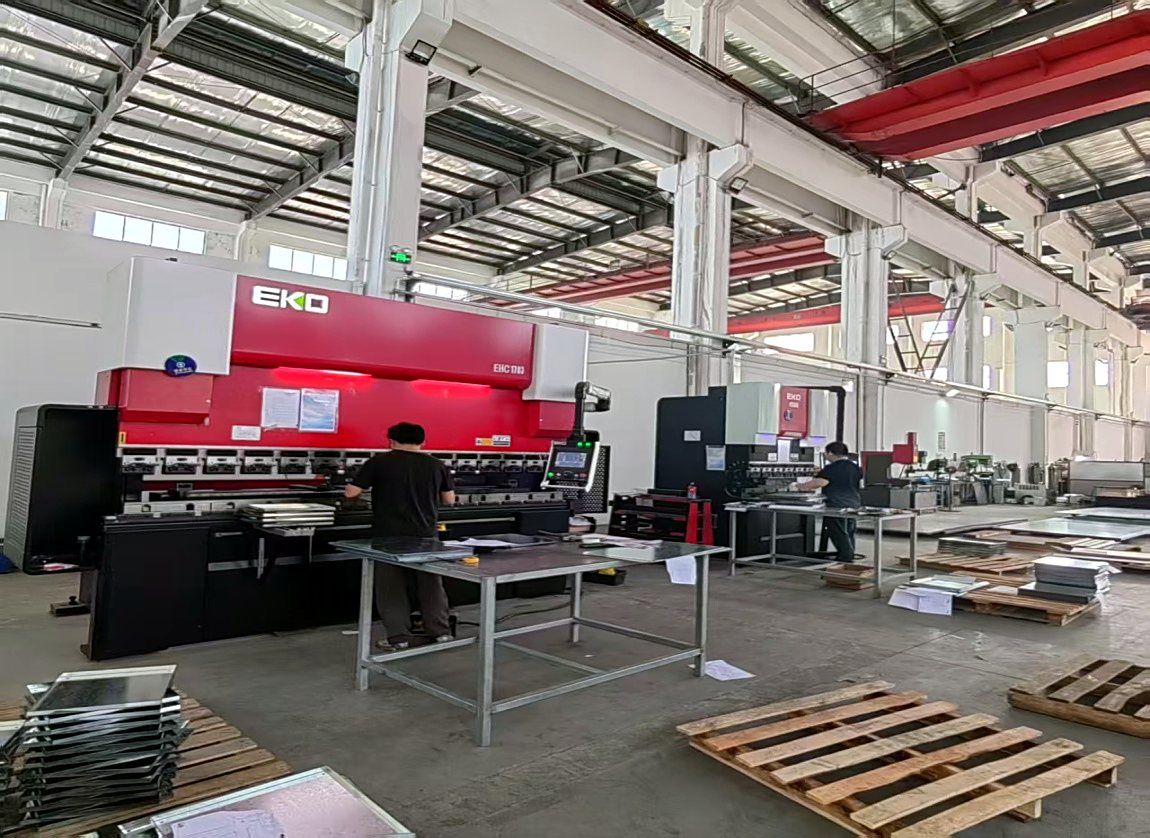
Stainless steel sheet metal fabrication for enclosures, panels, brackets and welded frames that must resist corrosion without paint. Sheets up to 1500 × 3000 mm are fiber laser cut, CNC bent up to 3 m and laser welded in-house, which keeps heat tint and distortion low. Passivation, brushing and polishing are done by qualified finishing partners.

| Grade in production | SUS304 (AISI 304, 1.4301); other grades confirmed per project |
|---|---|
| Max sheet size | 1500 × 3000 mm |
| Max thickness | 20 mm (laser cutting) |
| Bending | CNC press brakes, up to 3 m |
| Welding | Laser welding in-house |
| Largest cabinet | 3000 mm tall × 1500 mm wide |
| Finishing | Passivation, brushing (No.4/HL), polishing via partners |
SUS304 is the grade we run most and the default for indoor and general outdoor use. The table compares the grades buyers most often ask about; properties are typical published values, not guaranteed minimums.
| Grade (JIS / AISI / EN) | Type | Typical use | Notes |
|---|---|---|---|
| SUS304 / 304 / 1.4301 | Austenitic Cr-Ni | General enclosures, frames, food and lab equipment | Good formability and weldability; non-magnetic when annealed |
| SUS316 / 316 / 1.4401 | Austenitic Cr-Ni-Mo | Coastal, chloride or chemical exposure | Better pitting resistance than 304; higher material cost |
| SUS430 / 430 / 1.4016 | Ferritic Cr | Indoor decorative panels, appliance parts | Magnetic, lower cost, weaker corrosion resistance and weldability |
Austenitic stainless work-hardens and springs back more than SPCC, so bend angles are over-bent and checked on first pieces. A minimum inside radius of about 1 × t is a sound rule of thumb for SUS304; tighter radii are possible on thin sheet but raise the risk of cracking across the grain.
Visible faces are usually supplied with protective film. We cut and bend with the film on where possible; mark the cosmetic side on your drawing so it stays protected.
Laser welding puts a narrow, concentrated heat input into the joint. On thin stainless that means less warping and a smaller heat-tinted zone than TIG welding, so less grinding and straightening afterwards. See our laser welding page for joint design.
Any heat tint that remains reduces corrosion resistance at the weld. If the part goes into a corrosive environment, specify pickling and passivation, for example to ASTM A967 or A380, and we arrange it with a finishing partner.
| Finish | Description | Where it is done |
|---|---|---|
| 2B | Mill finish, smooth matte gray | As supplied |
| BA | Bright annealed, reflective | As supplied |
| No.4 | Directional brushed finish | Sheet as supplied or brushed by partner |
| HL (hairline) | Long continuous brushed lines | Sheet as supplied or brushed by partner |
| Passivated | Chemical treatment restoring the passive layer | Finishing partner |
SUS304 is the grade we run routinely. 316 and 430 can be quoted; availability of the sheet is confirmed per project.
Our fiber laser cuts sheet up to 20 mm thick and 1500 × 3000 mm. Bending capacity depends on thickness and bend length, so we confirm thick-plate bends per drawing.
Passivation, pickling, brushing and polishing are done by qualified finishing partners and included in our quote and inspection.
Laser welding leaves less heat tint than TIG. Remaining tint can be removed by brushing or pickling and passivation through our partners.
Both depend on the part and are confirmed per project in the quote.
Custom sheet metal fabrication in Suzhou: enclosures and cabinets laser cut, bent and welded in-house. Sheet to 1500 × 3000 mm and 20 mm, bends to 3 m.
Low-distortion laser welding of enclosures, frames and stamped assemblies.
Austenitic stainless for corrosion-resistant stamped parts and enclosures.
Control boxes, cabinets and automation-equipment housings.
JIS B 0408 general tolerance tables for blanked and bent or drawn metal parts, grades A, B and C, and how to call them out on your drawing.
Include your annual volume and tightest tolerance, and we can quote tooling and unit price right the first time.