Send your drawing. Get a quote in 1 business day.
Include your annual volume and tightest tolerance, and we can quote tooling and unit price right the first time.
Progressive die stamping forms a part in several stations as coil strip moves through one die, so every press stroke delivers a finished part. For small parts above roughly ten thousand pieces a year, it is the lowest-cost route. We run progressive dies on 60–250 ton high-speed presses with servo coil feeders.
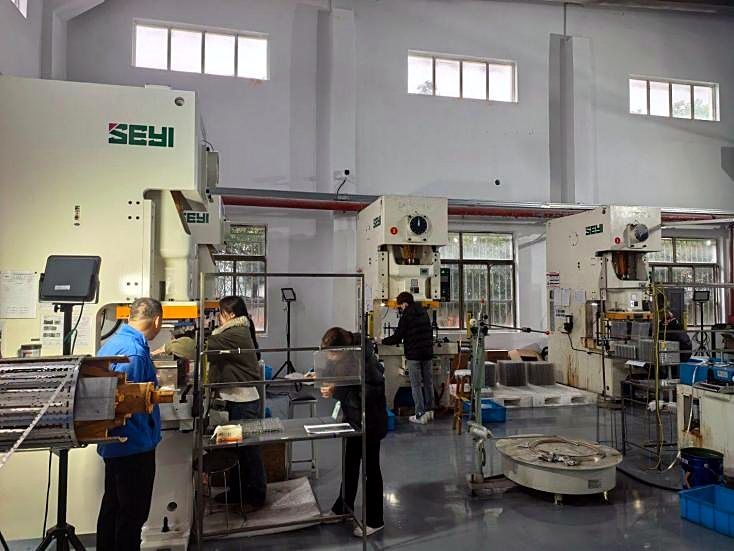
| Presses | 60–250 T high-speed, coil fed |
|---|---|
| Largest bed | 2800 × 920 mm |
| Feeding | Servo feeders with straighteners |
| Strip thickness | 0.15–1.2 mm |
| Tolerance | ±0.02 mm on critical features |
| Best for | Small parts, high annual volume |
Coil strip is straightened and fed a fixed distance — the pitch — on each press stroke. Pilot pins locate the strip in pilot holes punched at the first station, so every station sees the strip in the same place. Each station does one job: piercing, notching, bending, forming, coining or embossing. The last station cuts the part off the carrier, or leaves it attached when parts are supplied on reel.
For you, that means low part-to-part variation and almost no handling cost, because every operation happens in one die and one setup.
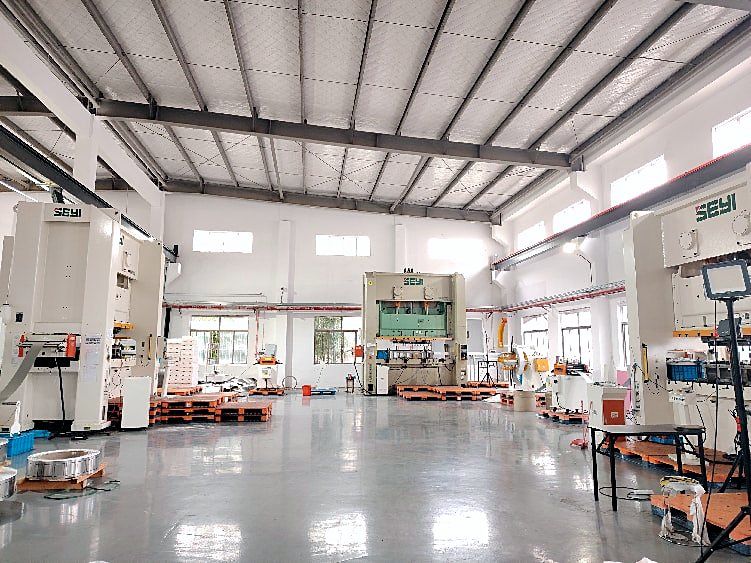
Below a few thousand parts a year, laser cutting and CNC bending usually beat both, because there is no die to pay for.
| Progressive die | Single-hit (stage) dies | |
|---|---|---|
| Tooling cost | Higher, one complex die | Lower per die, several dies |
| Unit cost | Lowest | Higher (handling between dies) |
| Part size | Small to medium | Medium to large |
| Typical volume | High annual volume | Low to medium volume |
| Supply on reel | Possible | No |
The strip layout decides material cost, die length and how many stations are needed. Parts are carried on a side carrier, a center carrier or both; nesting parts at an angle or in two rows can save material on small parts. On copper alloys, where material is a large part of the unit cost, layout review often matters more than press speed.
Grain direction is set by the layout as well. If a tight bend must run across the rolling direction, say so on the drawing so the layout respects it.
A first estimate of blanking and piercing force is the total cut length × material thickness × shear strength of the material. Forming, coining and stripper-spring forces are added on top, and a margin is left so the press does not run at its limit. Die length and the number of stations must also fit the press bed.
Our presses run from 60 to 250 tons with beds up to 2800 × 920 mm, which covers most small electronic and industrial parts in 0.15–1.2 mm strip.
Our partner toolroom builds each progressive die after a design review with our engineers. Tooling cost and lead time depend on the number of stations, part size and material, and are quoted per drawing. Once the tooling invoice is paid, the die is yours; we store and maintain it at our factory for your repeat orders.
The first parts from a new die go through a full dimensional check on a vision measuring system before production is released. Production lots are inspected by AQL sampling, with automated optical inspection on critical features.
As a rule of thumb, from about ten thousand pieces a year for small parts. We check the break-even against laser cutting and bending when we quote.
It depends on the number of stations and part complexity. Tooling lead time is confirmed per project in the quote.
You do, once the tooling invoice is paid. We keep and maintain it for your repeat orders.
Our production range is 0.15–1.2 mm strip, fed from coil.
Yes. Parts can be supplied on reel for automatic assembly; carrier and reel details are agreed per project.
1,000 pieces, although progressive dies make most sense at much higher annual volumes.
Precision metal stamping from Suzhou: shielding cans, terminals, clips and brackets held to ±0.02 mm. MOQ 1,000 pcs, ISO 9001, quotes in 1 business day.
How stamping tooling cost spreads over annual volume, when stamping beats laser cutting, and what to send for an accurate quote. Worked example inside.
Copper-alloy terminals, lugs and contacts, loose or on carrier strip.
One-piece and two-piece board-level shields in nickel silver and steel.
PCB, connector and mounting brackets stamped from steel, stainless and aluminum strip.
Tool-free prototypes and small batches, with a path to stamping.
Include your annual volume and tightest tolerance, and we can quote tooling and unit price right the first time.